

Human Resources is the backbone of every organisation — managing people, culture, compliance, payroll, and employee experience. But as companies scale, the question becomes unavoidable: Should HR be managed internally or outsourced to specialists? Both models offer distinct advantages, and choosing the right one can significantly impact cost efficiency, productivity, governance, and employee satisfaction.
Today, organisations of all sizes — startups, mid-sized firms, and large enterprises — are evaluating the benefits of outsourcing HR functions such as payroll, compliance, onboarding, HR documentation, and background checks. The rise of modern HR outsourcing firms has made it easier than ever for businesses to streamline operations while maintaining precision and compliance.
This blog provides a clear, analytical breakdown of in-house HR vs outsourced HR, helping you identify the best fit for your business needs.
Understanding the Two Models
What is In-House HR?
In-house HR refers to building and managing an internal team responsible for recruitment, payroll, performance management, employee relations, and compliance. This team works within the organisation, closely aligned with leadership and company culture.
What is Outsourced HR?
Outsourced HR involves partnering with specialized HR agencies to manage functions such as payroll, compliance, documentation, employee onboarding, verification, and administrative processes. Outsourcing can be partial or complete depending on your business requirements.
Today’s HR outsourcing partners bring advanced automation tools, compliance expertise, and multi-industry experience — allowing companies to operate more efficiently at lower cost.
In-House HR: Strengths, Challenges & Best Use Cases
Advantages of In-House HR
1. Greater Control and Oversight
Internal HR teams work closely with every department and leadership, allowing for stronger cultural alignment and direct oversight. Problems are identified and resolved faster because HR is deeply embedded in the company.
2. Stronger Employee Engagement
Employee relations often require human warmth, familiarity, and presence. An in-house team can conduct one-on-one conversations, drive engagement activities, support conflict resolution, and manage grievances with more context and empathy.
3. Deep Understanding of Company Culture
HR professionals who work internally understand team dynamics, leadership behavior, and organizational culture better. This helps them align hiring, retention strategies, and performance systems more effectively.
Challenges of In-House HR
1. High Operational Cost
Maintaining an HR team involves salaries, training, HR tech tools, infrastructure, and compliance management. As a company scales, these expenses grow significantly.
2. Limited Specialization
HR today is complex — from payroll law changes to POSH compliance to specialized background checks. Internal teams often lack deep expertise in every area, increasing compliance risks.
3. Time-Consuming Administrative Work
When internal HR teams handle routine administrative tasks like payroll processing or document verification, they have limited bandwidth for strategic functions such as training, culture building, or leadership development.
When In-House HR Works Best
- For companies that require daily on-ground employee support.
- When internal culture-building is a priority.
- For businesses with slower growth where administrative workload is manageable.
- When leadership prefers direct oversight of HR processes.
Outsourced HR: Strengths, Challenges & Best Use Cases
Advantages of Outsourced HR
1. Cost Efficiency & Operational Savings
Outsourcing eliminates the need for full HR staff, software subscriptions, compliance audits, or ongoing training costs. Many companies partner with a full-service payroll agency in Gurugram to reduce the time and cost involved in monthly payroll operations.
2. Higher Accuracy and Compliance
Payroll errors, incorrect deductions, and compliance lapses can result in penalties and employee dissatisfaction. Outsourcing ensures access to professional-grade tools and experts who stay updated on labor laws and tax regulations.
Several NCR-based companies rely on the best payroll outsourcing firm Delhi NCR to maintain error-free, timely payroll cycles — especially during rapid scaling or multi-city expansion.
3. Access to Specialist Expertise
Outsourcing partners provide deeper expertise in payroll, tax law, statutory compliance, onboarding, documentation, and audits. This is especially useful when companies need end-to-end payroll services in Gurugram to maintain complete accuracy without stretching internal resources.
4. Advanced Technology & Automation
Most HR outsourcing firms use modern HRMS platforms that automate attendance, leave, payroll, employee records, and compliance workflows — tools that smaller companies would struggle to maintain independently.
5. Reduced Administrative Burden
By outsourcing tasks such as employee onboarding, background checks, documentation, and payroll, internal HR teams can focus on talent development, performance management, and workforce planning.
Challenges of Outsourced HR
1. Less Direct Control
Companies may feel they have less visibility into processes when handled externally, especially if proper communication systems aren’t set up.
2. Potential Delays in Issue Resolution
Since the team is not physically present, some problems may require more time to communicate and resolve.
3. Dependence on External Systems
Outsourcing works best when the partner is reliable, responsive, and technologically sound. Choosing the wrong vendor can disrupt operations.
When Outsourced HR Works Best
- For fast-growing companies scaling teams across multiple locations.
- For startups that need accurate payroll without building a full team.
- For companies seeking the best payroll service provider near me to manage compliance-heavy functions.
- For businesses with lean internal teams that want to focus on strategic HR rather than admin.
- For organisations needing expert-level verification processes — especially when partnering with a background verification company in Gurugram or accessing employee verification services in Delhi NCR for bulk hiring.
In-House HR vs Outsourced HR: A Comparative Breakdown
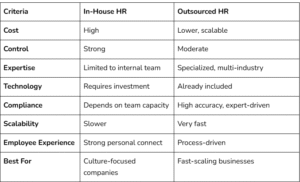
This comparison shows that each model excels in different areas. The right choice depends on your company’s size, growth stage, compliance needs, and HR workload.
Hybrid HR: The Best of Both Worlds
Many modern companies are now using a hybrid model where:
- Strategic HR stays in-house (engagement, performance, culture)
- Administrative HR is outsourced (payroll, compliance, documentation, verification)
This blend ensures reduced workload and increased accuracy while preserving cultural alignment and strong employee relationships.
A hybrid model also helps companies stay flexible and cost-efficient during growth phases, without sacrificing operational quality.
Conclusion: Choosing the Right HR Model for Long-Term Success
The decision between in-house HR and outsourced HR depends on your organisation’s priorities — whether you value control and cultural closeness or efficiency and specialization. In-house HR offers strong employee connect and oversight, while outsourced HR delivers scalability, precision, and significant cost savings. For many businesses, the best solution lies in a hybrid approach that merges internal engagement with expert-led operational support.
Partnering with the right HR outsourcing expert can transform the way your organisation handles payroll, compliance, and verification. This is where Lyftr Talent Solutions becomes a strategic ally — offering reliable, technology-enabled, end-to-end HR support to help businesses stay compliant, efficient, and future-ready.